
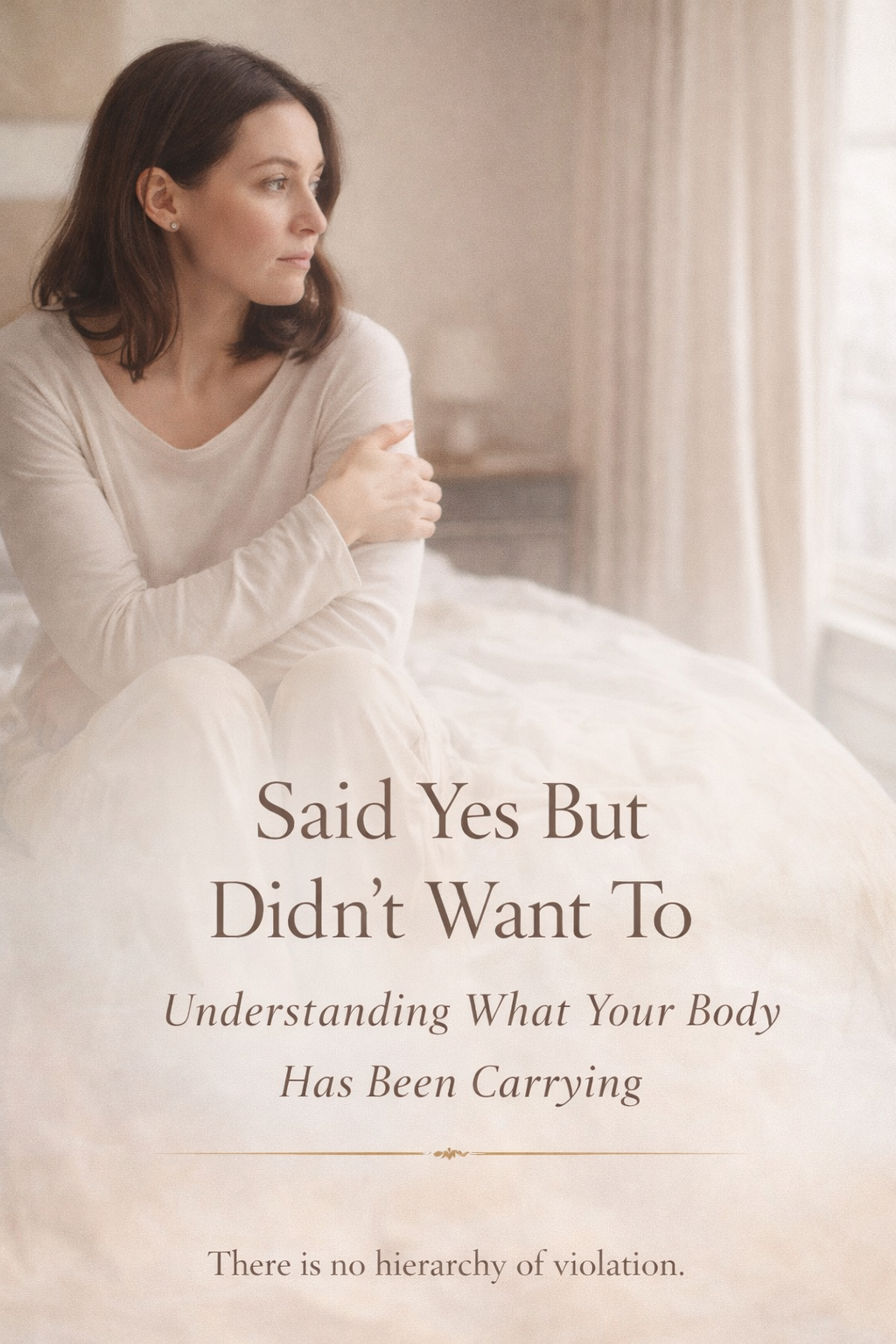
If you have ever said yes — not because you wanted to, but because it felt like the only way to make the pressure stop — this is written for you.
What you lived through has a name.
It is called sexual coercion. And within marriage, it is still a form of violation — not because it was violent, but because it was not freely chosen.
What Does “Said Yes But Didn’t Want To” Mean?
Saying yes when you do not want to—because of pressure, guilt, or emotional consequence—is often a form of sexual coercion.
It does not always involve force.
But it does involve the absence of freely given consent.
When “Said Yes But Didn’t Want To” Becomes a Pattern
It does not begin with force.
It begins with pressure.
Repeated asking after a clear no. Sulking or withdrawal used as consequence. Guilt framed as love. Obligation dressed up as partnership.
So over time, the question shifts.
It stops being: “Do I want this?”
And becomes: “How do I make this stop?”
Because of this slow conditioning, many women find themselves saying yes because, quite simply, we have no desire. We are exhausted. The yes comes from the need to survive.
The Context No One Sees
You were not simply uninterested.
Your body was in pain. Chronic illness. Infections. Physical discomfort that made even existing feel heavy.
And still — your no was negotiated.
Your pain was not treated as a boundary. It was treated as an inconvenience. And when you held your ground, there was a cost:
Emotional withdrawal. Tension in the home. The weight of being made responsible for his feelings.
So your body learned something quickly and quietly:
Peace comes from compliance.
When Intimacy Becomes Something You Endure
So, there comes a moment — quiet, often unnoticed — where intimacy changes shape.
It is no longer something you enter. It becomes something you endure.
Even so, the world outside sees nothing wrong. Because from the outside, nothing looks wrong.
But inside, you begin to disconnect from your body, from desire, from affection itself. Because even kindness begins to feel like a doorway to expectation.
So you stop initiating. You stop softening. You stop offering warmth.
Nope! You are not cold. This happens but because your body is protecting you.
The Moment That Clarifies Everything
Sometimes there is an incident that brings the truth into sharp focus.
Not because it is the only harm — but because it is unmistakable.
An ultimatum. A condition for staying. A demand disguised as choice.
And in that moment, something inside you knows:
This is not intimacy. This is survival under pressure.
“You did not say yes because you wanted to.
You said yes because it felt like the only way to make it stop.”
The Second Wound: Being Minimized
If the experience itself was not enough, there is another layer that cuts just as deeply.
Not being believed. Not being understood. Not being held in the truth of your experience.
Instead, what you hear is:
“It wasn’t that bad.” “I understand why he felt rejected.”
And suddenly the focus shifts from your violation to his feelings. From your body to his needs. From your truth to a comparison.
I want to say this unequivocally—and I want you to let it land:
Pause here. Let this settle in your body.
There is no hierarchy of violation.
Not based on how it happened.
Not based on how often.
Not based on whether others understand it.
Coercion is not lesser because it is quiet. It is not lesser because it happens over time. It is not lesser because it occurs within marriage.
The damage is not measured by volume. It is measured by what it takes from you.
What It Leaves Behind
Not just resentment.
Disconnection.
Touch feels unsafe. Closeness feels loaded. Your body tightens instead of opens. Even the idea of intimacy brings resistance where desire used to live.
And then the narrative turns: “You’ve changed.” “You don’t love me the same.”
But what is left unspoken is this:
You adapted to survive what was happening to you.
That is not damage. That is intelligence.
Why You Are Not Broken
Many women who have said yes when they didn’t want to
begin to internalize it as personal failure.
Something is wrong with me.
I’ve changed.
I’m too sensitive.
But your body is not malfunctioning. It is responding accurately to repeated experiences where your no was not fully honored.
Even without physical force, the consistent override of your boundaries impacts the body deeply. The result is often tension during intimacy, numbness, anxiety, emotional shutdown.
Your body is not rejecting your partner. It is protecting you. And there is a significant difference between those two things.
When Someone Says They Want to Change
Change matters.
But so does history.
Because your body does not respond to words. It responds to lived experience — accumulated, felt, remembered in the nervous system.
Trust is not rebuilt through intention alone. It is rebuilt through consistent respect of your boundaries. No pressure, even in moments of desire. Accountability without defensiveness. Space for your experience to exist without being debated.
And even then, you are allowed to decide what you want.
A Quiet Question to Sit With
Not “Can this be fixed?” Not “Is he changing?”
But:
“What feels true for me now?”
Because healing does not require you to stay.
And leaving does not require you to prove how bad it was.
You Are Not Alone in This
If this is your story — or even part of it — let this be the place where it is no longer minimized.
Not by others. And not by you.
If This Is Landing Somewhere Deep in You
You do not have to continue navigating this alone.
Inside Soul Repair, we gently work with what your body has been holding—
restoring safety, understanding your responses, and rebuilding connection with yourself at your own pace.
And for those who are ready to step more fully into this work, the Soul Story Retreat offers a deeper, immersive space to begin again—without pressure, without performance.
You are allowed to heal in a way that honors you.
And if you are ready for something more immersive, the
SOUL STORY RETREAT holds space for exactly this kind of healing — unhurried, embodied, and deeply personal.
There is nothing weak about what you endured. And there is nothing wrong with the part of you that no longer wants to return to it.
Dr. Sandra Hamilton Cultivating Quiet Power & Lasting Confidence
FAQ
Is sexual coercion the same as assault? Sexual coercion involves pressure, manipulation, or guilt to obtain sex without full consent. While it may not always involve physical force, it can still be deeply violating and the impact on your body is real regardless of how others define it.
Why do I feel repulsed by my partner? This is often a protective response from your body after repeated experiences of pressure or emotional unsafety. It is not dysfunction. It is your nervous system doing exactly what it was designed to do.
Is it normal to lose desire in a relationship like this? Yes. Loss of desire is a very common response when intimacy becomes associated with obligation, consequence, or emotional pressure rather than genuine safety and connection.
Can therapy or healing work help? Yes. Trauma-informed, body-aware approaches — like RTT and the work we do inside Soul Repair — can help you reconnect with yourself and understand your responses without shame.
0 Comments